Over the last few months, I have been leading the digital strategy and execution for Furhan Ahmad, a retired FDNY Firefighter who is running for the 66th District of the NY State Assembly. Today, I'll walk through some of the ways we've used AI as a competitive advantage within the campaign.
Software on Demand
I have built a campaign OS from scratch that is tooling to run the digital components of the campaign. This means that instead of spending scarce budget on software licenses, we can focus spend on other parts of the campaign that truly need the resourcing to succeed. Here are some examples and rough math:
Website: I built the branding for the campaign in Figma, and then used Codex to convert the branding to build the website (this is before Claude Design existed!). The site is built in Next.js, but renders statically and is hosted on S3 with Cloudfront. This means we get amazing performance, with almost zero cost. There are some cases where we need a backend - for example, I built a District Lookup tool, which hits API Gateway/Lambda. The newsletter, volunteer and event signups are simply forms that send to a Google Sheet. Becuase Codex has the existing site as context, its dead-simple to extend it. Need a landing page? No problem. Need a new widget - done! Merges to main auto deploy to S3 and invalidate cloudfront. Estimated savings: $250
CRM: I hate Hubspot, Salesforce, and just about any other legacy CRM. This campaign needed something simple and effective - not somethign that would take mohts to learn and configure. I swarmed around Airtable to be the command center for our community data. We're pulling in from various sources (the aforementioned Google Sheet being one of them), and tagging contacts appropriately. This allows for easy segmentation when needed. For example, we will be activating our volunteers by sending and email to the Volunteers segment - which is simply a view in Airtable. Even cooler is that we can use the Airtable API to programmatically create tables within our base using Codex. Estimated savings: $2400
Email: This is where I had the most fun. With the contacts already in Airtable, I simply needed an interface to compose the email and send to one of my segments. I find it exceedingly frustrating that ESPs like Mailchimp or Hubspot bill based on contacts. I used Claude Code, Claude Design, and Codex to build a pretty darn cool interface for sending emails. On the backend the interface uses Amazon SES, which is ridiculously inexpensive for this use case. On the frontend, it's a locally hosted Next.js app that lets me pull in prebuilt emails from my Weekly Emails planning table, uses AI to map the content to the template, suggests subject lines and preview text, and then allows me to finalize, approve, test, and send to any of my Airtable contacts views.
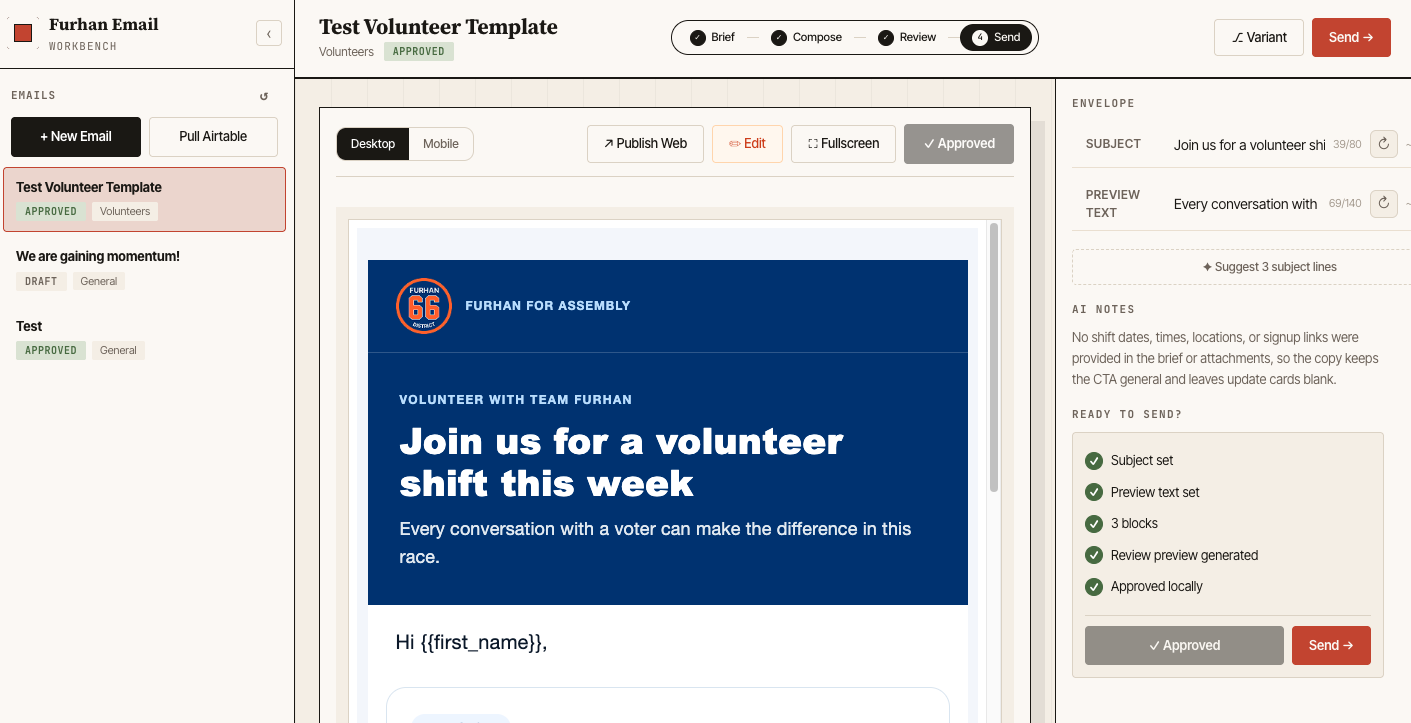
Today, I shipped a feature that creates a 1-click registration email for our volunteers. Our Field Manager build shifts in Airtable, and Email Workbench has a Volunteer Shifts component that pulls in the open shifts. Again, a Lambda middleware handles secure communication with Airtable, and we've got ourselves a one-click registration for canvassing or phone banks. Estimated Savings: $500
No Google Workspace: Why pay $15/month for every single person on the team when everyone already has a Gmail account? Earlier this year, I had signed up for MXroute. With that, I get unlimited email addresses on as many domains as I want. For most of the emails, we've just setup forwarding to a single gmail account. This enables a "single throat to choke" when it comes to compliance in addition to saving the campaign money. Estimated savings: $500
In addition to all of this, the entire team uses a set of tools that are core to how we work (Claude, ChatGPT, Slack, etc.). What I've learned is that the campaign, like film productions, is a swarm-type situation. A team is spun up for a short period of time (spin up until election day), and then disbanded with (hopefully) a win. Committing to SaaS contracts and pricing is wasteful. In the era of AI bespoke software is a way to avoid that waste and refocus the spend on the humans that we need to hire to get the message out.
If you'd like to learn more about the tech stack, reach out.